
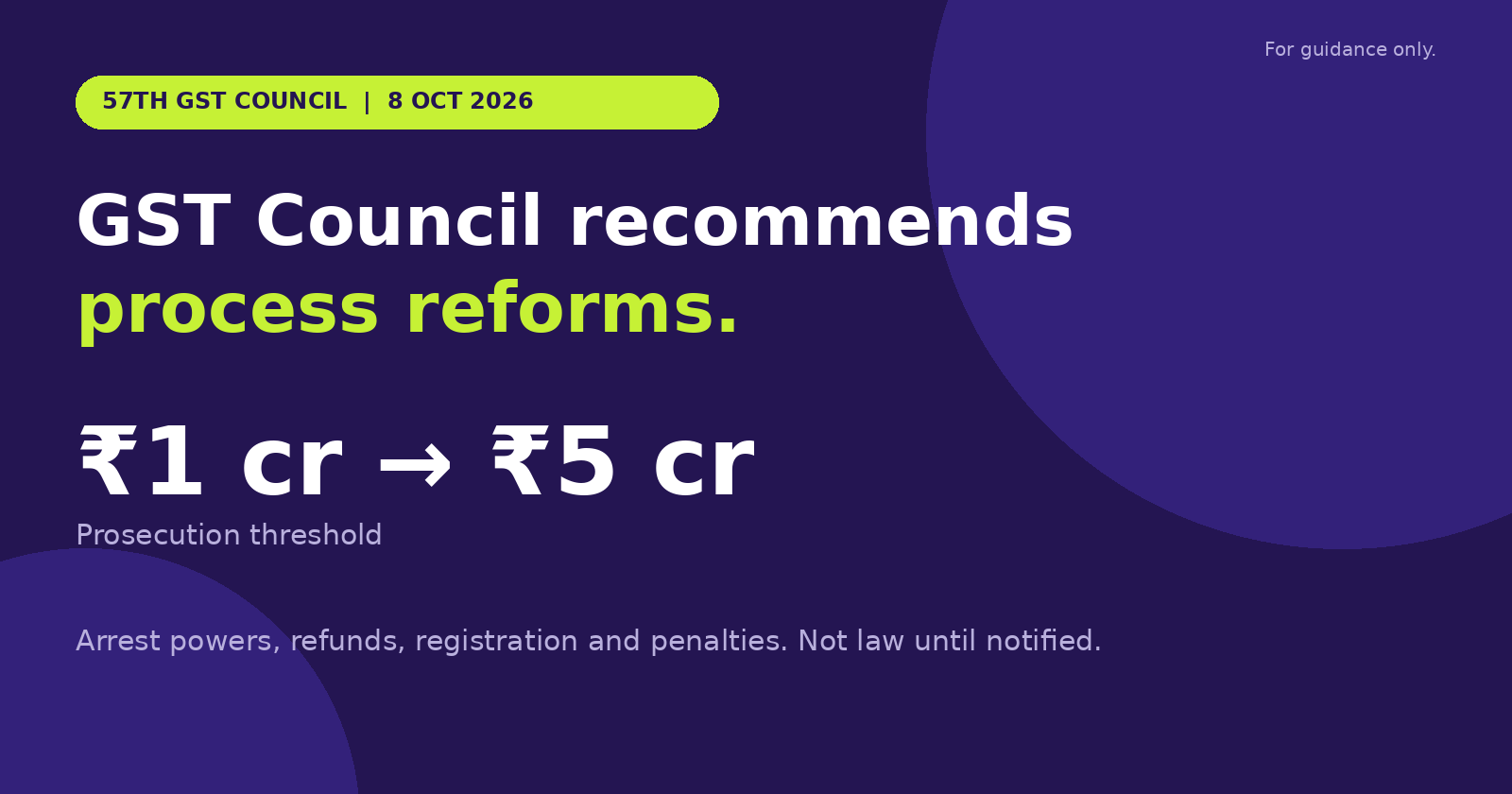
What did the 57th GST Council meeting recommend?
The 57th meeting of the Goods and Services Tax (GST) Council, held in New Delhi on 8 October 2026, recommended process reforms across registration, returns, refunds and dispute resolution, plus trade-facilitation measures and rate clarifications. The official release says the 56th meeting focused on rate rationalisation, while this one focused on process.
These are recommendations only. They take effect through notifications, circulars and law amendments, which alone carry legal force.
What changes for arrest, prosecution and penalties?
The Council recommended omitting arrest powers under GST and raising the prosecution threshold fivefold, from ₹1 crore to ₹5 crore.
| Area | Recommendation |
|---|---|
| Arrest powers | Omit section 69 of the Central Goods and Services Tax (CGST) Act, 2017 |
| Prosecution threshold | ₹1 crore to ₹5 crore, with changes to the offences in section 132 |
| General penalty (section 125) | Maximum cut from ₹25,000 to ₹10,000 |
| Show cause notices | None where the tax involved is below ₹10,000 (CGST, SGST, IGST and cess together); pending smaller notices decided as if the threshold applied |
| Penalty after adjudication | 5% in non-fraud cases if tax and interest are paid within 30 days (section 73) or 60 days (section 74A) of the order; minimum penalty of ₹10,000 removed in non-fraud cases |
| Appeal pre-deposit | Capped at ₹40 crore (₹20 crore CGST and ₹20 crore SGST) where the order involves only penalty |
| Blocking of credit (rule 86A) | Taxpayer can file an objection and get a personal hearing |
How will registration, returns and refunds change?
The Council recommended more automation, so fewer registration, return and refund steps need an officer.
- Registration. A circular and FAQs on required documents, drop-down document selection in Form GST REG-01, and automatic acceptance of amendments to all registration details except the principal place of business.
- Cancellation. Applications in Form GST REG-16 accepted automatically once pending returns are filed and dues paid. The first phase covers taxpayers who passed on input tax credit of no more than ₹2.5 lakh in any month or filed the final return in time. The second phase covers all applications.
- Small e-commerce sellers. Registration under a new rule 14B by declaring the e-commerce operator's warehouse as the principal place of business, for sellers passing on credit of no more than ₹2.5 lakh a month.
- Returns. An alternate mechanism to correct liability and credit mismatches between Forms GSTR-1, GSTR-2B and GSTR-3B, proposed from the April 2027 return after public consultation.
- Refunds, phase 1. Full refund of excess cash ledger balance sanctioned automatically, acknowledgement or deficiency memo within 10 days instead of 15, and 90% of zero-rated and inverted-duty claims sanctioned provisionally.
- Refunds, phase 2. Automated acknowledgement, then full sanction of zero-rated claims after adjusting any pending dues.
What else did the Council recommend on credit, exports and small businesses?
The release also covers blocked credit, export refunds, e-way bills and relief for turnover up to ₹5 crore.
- Blocked credit. Section 17(5) restrictions removed on, among others, outdoor catering, health and life insurance, telecom towers, pipelines outside factory premises, free samples, and goods destroyed or written off on expiry of shelf life as required by law.
- Refund of accumulated credit. Extended to capital goods (zero-rated supplies) and to input services and capital goods (inverted duty), with the dates in the next section.
- Export of services. The condition that supplier and recipient not be establishments of a distinct person is removed, easing refunds for services supplied to foreign offices or branches.
- Late fee. Waived on delayed section 39(1) returns for taxpayers with turnover up to ₹5 crore in the preceding financial year, if filed by the end of the month in which they were due.
- Optional scheme. A concept note for Annual Return Quarterly Payment (ARQP) approved in principle, for taxpayers with turnover up to ₹5 crore who supply only to unregistered persons.
- E-way bills. Interception only on specific intelligence, authorised by an officer not below Joint Commissioner, with no interception in transit states.
- E-invoicing. Extended to reverse-charge supplies from unregistered persons and to imports of services, for turnover of ₹5 crore and above.
When do the recommendations take effect, and which rates change?
Only three dates appear in the release. Everything else follows notifications, circulars and law amendments.
| Item | Date or status |
|---|---|
| Refund of accumulated credit on input services (inverted duty) | Credit availed on or after 1 November 2026 |
| Refund of credit on capital goods, spread over 60 months | Credit availed on or after 1 April 2027 |
| Alternate mechanism to correct liability and credit in returns | From the April 2027 return, after public consultation |
| All other recommendations | When rules, circulars or law amendments are notified |
Selected rate and classification recommendations:
- Electric vehicles. An option to pay 5% GST with restricted credit on passenger transport and motor vehicle rental where battery charging is included in the price.
- Delivery through e-commerce operators. 5% without credit for delivery services supplied or ordered through an operator.
- Same line of business. Limited credit for restaurant and outdoor catering, hotel stays up to ₹7,500 per unit per day, and gym or fitness services.
- Waste and scrap. Reverse charge on plastics, electronics, tyres and used cooking oil from unregistered suppliers, with 2% tax deducted at source on business-to-business supplies.
- Nil rate and exemptions. Nil GST on psyllium seeds, and exemptions for seed storage and coffee curing services.
What should businesses do now?
- Separate recommendation from law. Track notifications and circulars from the Central Board of Indirect Taxes and Customs (CBIC) before changing any process.
- Review notices and refunds. List open notices below ₹10,000 and pending refund claims, and note which would benefit from the proposed rules.
- Map your credit. Check blocked-credit items under section 17(5) and refund eligibility for input services and capital goods.
- Check small-business eligibility. Confirm whether turnover of up to ₹5 crore qualifies you for the late-fee waiver or the quarterly-payment scheme.
- Reconcile early. Match GSTR-1, GSTR-2B and GSTR-3B now, ahead of the proposed April 2027 correction mechanism.
Our GST service can review open notices, refund claims and credit positions. The GST calculator helps with the CGST, SGST or IGST split.
Bottom line
The recommendations ease penalties, prosecution and refund delays, but nothing changes until it is notified. PSP Consultancy can help you review open notices, refund claims and credit positions. Message us to get started.
Related
Other rule changes this month: UPI MDR from 15 October, the EPF wage ceiling checklist and the new FEMA export-import regulations.
Frequently asked questions
Are the GST Council's recommendations law?
No. They take effect only when given effect through notifications, circulars or amendments to the law, which alone carry legal force.
Did the 57th meeting change GST rates?
Not broadly. The official release says the 56th meeting focused on rate rationalisation, while the 57th focused on process reforms, clarifications and trade facilitation, with a few rate and exemption changes.
Will arrest powers under GST be removed?
The Council recommended omitting section 69 of the CGST Act, which gives arrest powers. This needs a law amendment.
What is the recommended prosecution threshold?
The Council recommended raising it from ₹1 crore to ₹5 crore.
What is the recommended maximum general penalty?
The maximum general penalty under section 125 would fall from ₹25,000 to ₹10,000.
Is there late-fee relief for small taxpayers?
Yes. Late fee on delayed section 39(1) returns would be waived for taxpayers with turnover up to ₹5 crore in the preceding financial year, if the return is filed by the end of the month in which it was due.
When will the refund changes apply?
Refund of credit on input services (inverted duty) applies to credit availed from 1 November 2026, and on capital goods from 1 April 2027. The other refund automation follows notification.
Sources
- Ministry of Finance, Press Information Bureau (PIB): Recommendations of the 57th Meeting of the GST Council (8 October 2026)
- GST Council: meeting recommendations and circulars
- GST Portal: notifications, forms and updates
This article is general information based on public notifications and reporting as of 2026-10-17, and is not professional advice for any specific situation. Rules can change or be clarified after publication. Confirm the current position before acting.