
What is changing
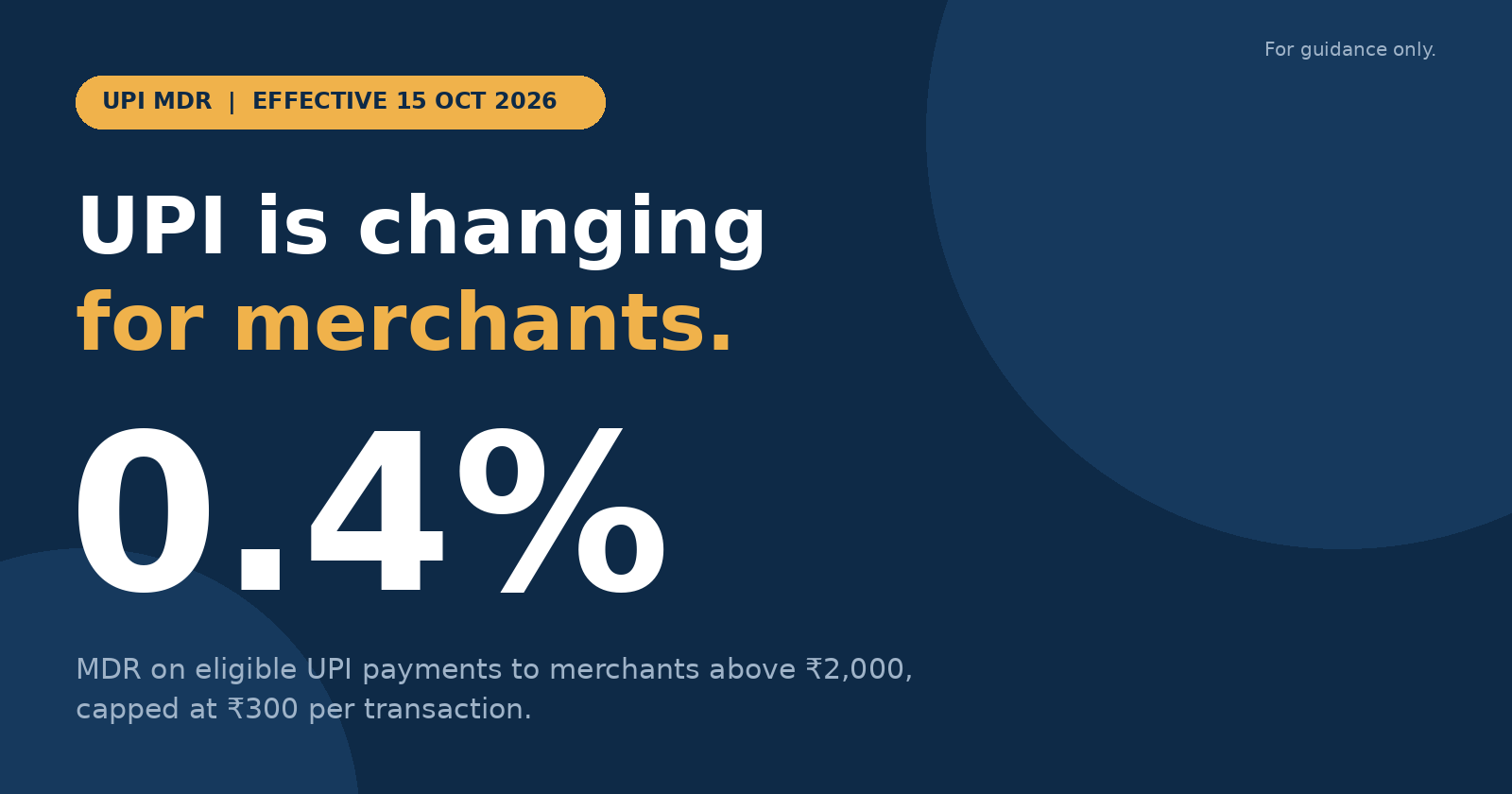
The Union government confirmed on 15 September 2026 that UPI payments to merchants above ₹2,000 will attract a Merchant Discount Rate from 15 October 2026. The structure, published through NPCI, is the first formal MDR regime for UPI. It applies to a narrow slice of transactions: NPCI has said that payments up to ₹2,000, which make up more than 95% of person-to-merchant UPI volume, are not affected.
The charge is borne by the merchant. Person-to-person transfers remain free, and banks have been advised to ensure that merchants do not pass the MDR on to customers.
MDR rates at a glance
| Payment type | MDR | Notes |
|---|---|---|
| Person-to-merchant, up to ₹2,000 | Nil | Applies to all merchants |
| Standard person-to-merchant, above ₹2,000 | 0.4% | Capped at ₹300 per transaction; the cap bites from ₹75,000 |
| Railways, telecom, insurance, fuel, agricultural inputs and utility bills, above ₹2,000 | Flat ₹5 | Replaces the 0.4% for these sectors |
| Mutual funds, securities, stockbrokers and dealers | 0.02% | Capped at ₹300 |
| Person-to-person transfers | Nil | Not part of the MDR framework |
| UPI AutoPay mandates | Nil | Recurring payments such as subscriptions and utility bills |
Who is exempt
- Customers. The MDR is a merchant-side charge and UPI apps cannot add a platform fee.
- Small merchants. Merchants receiving up to ₹1 lakh a month through UPI QR codes into a bank account fall under the person-to-person-merchant (P2PM) category and pay no MDR. Reports on the framework say that a merchant whose inflows stay above ₹1 lakh a month for three consecutive months moves to the regular category.
- Small-value payments. Anything up to ₹2,000.
- Autopay. Recurring UPI mandates.
Worked examples
| Payment | Category | MDR |
|---|---|---|
| ₹2,000 | Standard | ₹0 |
| ₹3,000 | Standard | ₹12 |
| ₹10,000 | Standard | ₹40 |
| ₹50,000 | Standard | ₹200 |
| ₹75,000 | Standard | ₹300 (0.4% equals the cap) |
| ₹1,00,000 | Standard | ₹300 (0.4% would be ₹400) |
| ₹20,000 fuel payment | Specified sector | ₹5, not ₹80 |
| ₹50,000 mutual fund payment | Capital markets | ₹10 |
Use our UPI MDR calculator to test your own ticket sizes and monthly volumes.
GST on MDR
GST is reported to apply at 18% on MDR, as it does on other payment-processing charges, and GST-registered merchants can generally claim input tax credit on it if the conditions for credit are met. The rate and the invoicing arrangement depend on your acquiring bank or payment aggregator, so confirm both on the invoice you receive. See our GST service if you want the credit reconciled monthly.
What merchants should do before 15 October
- Read your acquiring agreement. Check how MDR will be deducted: netted from settlement or billed separately, and how often it is invoiced.
- Classify your merchant correctly. A small merchant exempt today may be reclassified if inflows stay high. Know which category your QR or account falls in.
- Estimate the cost. Pull a month of UPI payments, bucket them by size and sector, and apply the table above. High-ticket businesses feel it first.
- Do not add a surcharge. Passing MDR on to customers is not permitted. If the cost matters, adjust pricing openly, not through a separate UPI line on the bill.
- Update your books. Record MDR as a payment-processing expense, track the GST and credit separately, and reconcile settlements against gross sales. Our accounting outsourcing team can set this up.
- Keep PG fees separate in your head. Payment-gateway or platform fees are a different charge from MDR. Check that you are not being billed twice for the same thing.
Related
Employers face a payroll change at the same time: read the EPF wage ceiling checklist. Exporters should see what changed under the new FEMA export-import regulations.
Frequently asked questions
Will customers be charged for UPI payments from 15 October 2026?
No. MDR is a merchant-side charge. Person-to-person transfers and merchant payments up to ₹2,000 remain free, and UPI apps cannot add a platform fee.
What is the UPI MDR rate?
A 0.4% MDR applies to eligible person-to-merchant payments above ₹2,000. It is capped at ₹300 per transaction for payments of ₹75,000 and above.
Who is exempt from UPI MDR?
Payments up to ₹2,000, person-to-person transfers, UPI AutoPay mandates, and small merchants receiving up to ₹1 lakh a month through UPI QR codes fall outside the 0.4% rate.
Which payments have a different MDR?
A flat ₹5 applies above ₹2,000 for sectors such as railways, telecom, insurance, fuel, agricultural inputs and utility bills. Payments for mutual funds, securities and stockbrokers carry 0.02%, capped at ₹300.
Can a merchant pass the MDR on to the customer?
No. Banks have been advised to ensure merchants do not pass MDR on, so a separate UPI charge on the bill is not allowed.
Is GST charged on UPI MDR?
GST is reported to apply at 18% on MDR, and eligible GST-registered merchants can claim input tax credit. Confirm the rate on your acquiring bank's invoice.
Sources
- Business Today: UPI MDR rules explained (16 Sep 2026)
- Cashfree: UPI MDR rates from 15 October 2026
- Deccan Chronicle: NPCI announces 0.4% merchant charge
This article is general information based on public notifications and reporting as of 2026-10-06, and is not professional advice for any specific situation. Rules can change or be clarified after publication. Confirm the current position before acting.