
How we got here
| Date | Development |
|---|---|
| 13 January 2026 | RBI notifies the unified Export and Import of Goods and Services Regulations, 2026 (FEMA 23(R)/2026-RB), published in the Gazette on 15 January 2026, to take effect from 1 October 2026 |
| 5 June 2026 | An amendment to the 2015 export regulations brings the realisation period back from 15 months to 9 months |
| 22 September 2026 | RBI amends the 2026 regulations (FEMA 23(R)/(1)/2026-RB), cutting the realisation periods before they take effect; published in the Gazette on 24 September 2026 |
| 1 October 2026 | The 2026 regulations take effect and supersede the 2015 regulations, subject to savings |
What changed
The 2026 regulations consolidate the rules on exports and imports of goods, services and software into a single instrument. They replace the Foreign Exchange Management (Export of Goods & Services) Regulations, 2015 and are supported by RBI's directions to authorised dealer (AD) banks. The most visible changes for exporters are the realisation period, a leaner reporting process for service exports and simpler handling of small transactions.
Realisation periods
| Export | Period to realise proceeds | Counted from |
|---|---|---|
| Goods and software, in foreign currency | 9 months | Date of shipment |
| Services, in foreign currency | 9 months | Invoice date |
| Exports invoiced or settled in rupees | 12 months | As above |
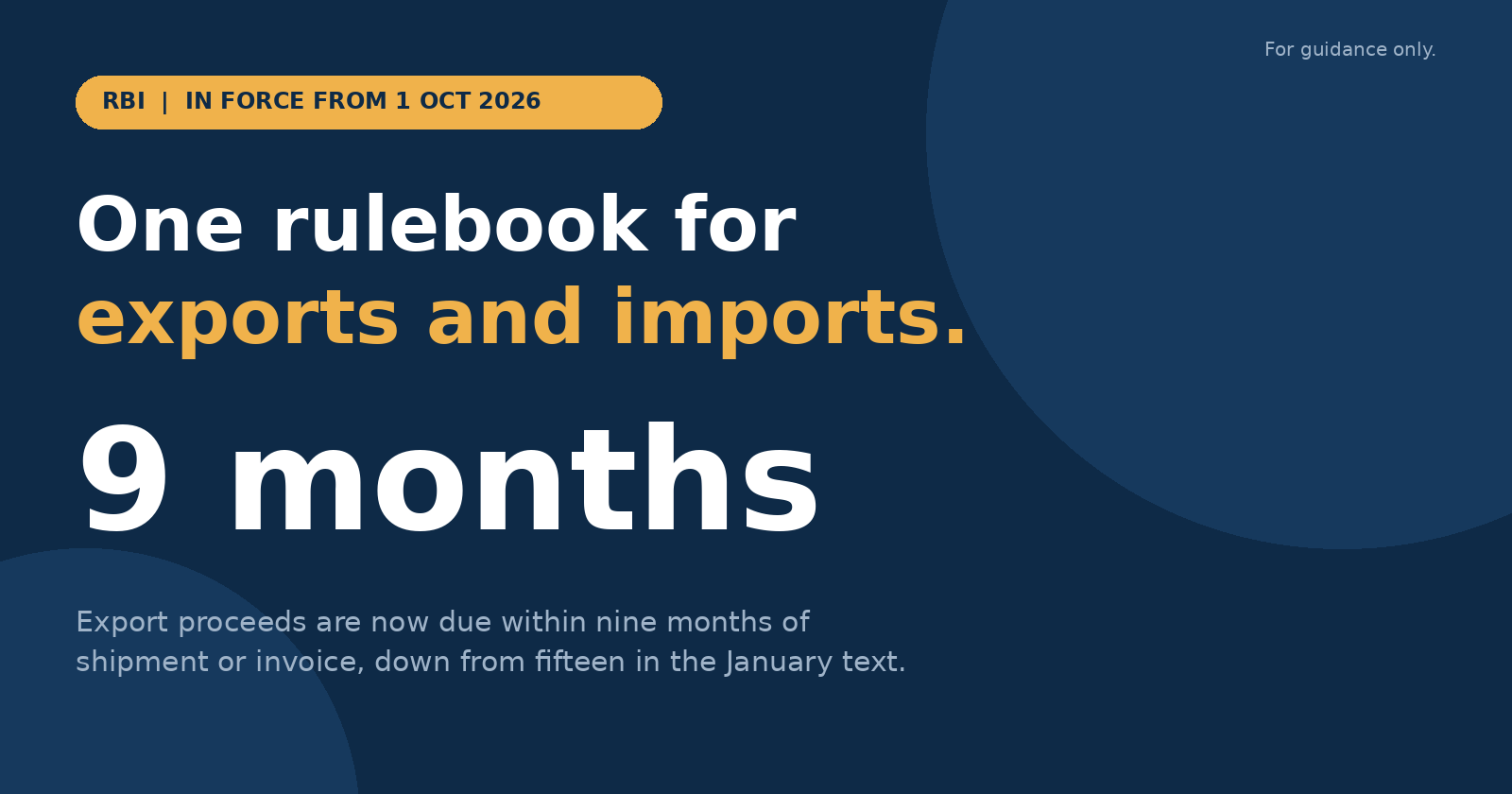
The 22 September amendment cut the periods from 15 to 9 months, and from 18 to 12 months for rupee exports. Banks can extend the period on request, with reasons. Work out the date for a specific shipment or invoice with our export realisation date calculator.
EDF for service exports
Service exporters file the Export Declaration Form (EDF) within 30 days of the end of the month in which the invoice was raised. One form can cover all of that month's service exports, which removes the need for a form per invoice.
Simpler rules for small transactions
For shipping bills or invoices up to ₹10 lakh, banks can close monitoring-system entries and allow reduced export value on the exporter's declaration, which reduces follow-up on small shortfalls.
Transition from the 2015 regulations
The September amendment also kept Caution List exporters under the earlier orders that apply to them, and let AD banks handle transactions undertaken before 1 October 2026 that previously needed RBI approval. If you have old, unrealised shipments or invoices, ask your bank which regime applies to each.
Exporter checklist
- Re-date your receivables. Build a list of every open shipment or invoice with its realisation deadline under the 9 or 12 month rule.
- Flag anything before 5 June 2026. An earlier, longer window may have applied. Confirm with your bank.
- Set up the EDF calendar for service exports: one filing per month, within 30 days of month end.
- Check your contracts. Payment terms longer than nine months now need a bank extension request, with reasons, before the date passes.
- Talk to your AD bank early. Ask how it will treat pre-October cases and what documents it wants for small-value closures.
- Keep evidence ready. Shipping bills, invoices, FIRCs or bank advices and correspondence on shortfalls.
Our FEMA advisory team prepares extension requests, tracks realisation and handles bank liaison.
Related
See also UPI MDR from 15 October and the EPF wage ceiling checklist.
Frequently asked questions
What are the FEMA export-import regulations, 2026?
They are the RBI's unified regulations (Notification FEMA 23(R)/2026-RB) covering exports and imports of goods, services and software. They replace the 2015 export regulations and took effect on 1 October 2026.
How long do exporters have to realise export proceeds?
Nine months from the date of shipment for goods or the invoice date for services, and twelve months where exports are invoiced or settled in rupees. Banks can extend the period on request, with reasons.
What did the 22 September 2026 amendment change?
It cut the realisation periods from 15 to 9 months, and from 18 to 12 months for rupee exports. It also kept Caution List exporters under earlier orders and let banks handle pre-October cases that needed RBI approval.
Are there simpler rules for small transactions?
Yes. For shipping bills or invoices up to ₹10 lakh, banks can close monitoring-system entries and allow reduced export value on the exporter's declaration.
When must service exporters file the Export Declaration Form?
Within 30 days of the end of the month in which the invoice was raised. One form can cover all of that month's service exports.
Sources
- RBI: Foreign Exchange Management (Export and Import of Goods and Services) Regulations, 2026 (amended up to 22 September 2026)
- RBI: Amendment Regulations, 2026 (FEMA 23(R)/(1)/2026-RB, 22 September 2026)
- TaxGuru: RBI's new FEMA export and import regulations, 2026 (guide)
This article is general information based on public notifications and reporting as of 2026-10-06, and is not professional advice for any specific situation. Rules can change or be clarified after publication. Confirm the current position before acting.